
If a storm brought a tree down on your property in Northeast Ohio, here is the order that matters: get clear of the tree, keep everyone away from anything touching a power line, document the damage for your insurer, then get it assessed before anyone starts cutting. Storm damage to trees usually looks more settled than it is. A downed tree can hold a lot of stored tension, and a tree still standing with a split trunk or a lifted root plate can come down the rest of the way hours after the wind dies.
We are a working tree service based in Chardon, and we handle storm damage cleanup across Geauga and Lake County. Below is what we tell our own neighbors when they call after a storm, from the first minute through the insurance claim and the decision on whether the tree can be saved.
First: Get Clear and Stay Safe
Do not approach downed trees, especially anywhere near power lines. A line that looks dead can still be energized, and it can energize the tree, the wet ground around it, and a metal fence twenty feet away. Keep family and pets back from the whole affected area, not just the tree itself.
If a tree has fallen on your home and you are inside, get out if you can do it safely. If you cannot get out safely, move to a room away from the damage and stay there until help arrives. Do not go up into the attic or onto the roof to look at it.
Who to call first
Work down this list in order. The right first call depends on what you are dealing with.
- Injuries or trapped people: call 911.
- Downed power lines: call your utility company. FirstEnergy in this area is 888-544-4877. Treat every line on the ground as live.
- Gas smell: leave the house, then call your gas company from outside or from a neighbor’s.
- A tree that needs to come off a structure or clearing: call All Trees Considered at (440) 901-0995. We run a 24/7 emergency tree service and can talk you through what is safe to touch before we get there.
A Downed Tree on Your House, Car, or Yard: What Each One Means
Where the tree landed changes how urgent it is and what you should and should not do while you wait. Fallen trees get handled differently depending on what they hit, so a tree on an occupied house is a different situation from a fallen tree lying flat in the back forty.
A tree on the house or roof
This is the one that comes first, every time. If people are inside, getting them out safely is the whole job until they are clear. Once everyone is out, do not climb up to inspect the damage and do not send anyone into the attic. A tree resting on a roof is still moving in small ways as the wood settles and the wind pushes it, and the roof structure under it may already be compromised.
If your electrical service mast was torn off the house or the lines were pulled loose, leave the power to the utility. Only kill power at the main panel if you can reach it without going near damaged wiring or standing water, and if you are not sure, leave it and tell the crew what you see when they arrive.
A tree on a car, fence, or shed
Lower stakes than an occupied house, but a tree on a car is still holding weight in ways that are hard to read. Do not try to move the vehicle out from under it and do not start pulling branches off to “lighten it.” Take your photos, keep people back, and let the tree come off in a controlled way. Fences and sheds can wait. There is rarely a reason to rush into a pile of storm wood for a shed.
A fallen tree in the open yard
If the tree came down clear of the house, the cars, and the lines, you have time. That does not make it safe to walk up on. A fallen tree lying on the ground is full of bent limbs pinned under the weight of the trunk, and those limbs are loaded like a spring. The root plate, the slab of roots and soil that levers up when a tree uproots, can drop back into its hole or roll the trunk if the balance shifts. Photograph it and leave the cutting to someone with the gear to control which way things move.
Document Everything for Your Insurance Claim
Once you are safe and the immediate hazards are handled, take photos and video before any cleanup starts. This documentation is what your insurance claim runs on, and once the tree is cut up and hauled off, you cannot go back and get it. Photograph: We also wrote up how tree damage insurance claims work, including what we hand you for the adjuster.
- The tree and exactly where it fell.
- Damage to the house, the roof, vehicles, fences, or anything else it hit.
- The root plate if the tree uprooted, including the hole it pulled out of.
- Any pre-existing conditions that are visible, like old decay in the trunk or a prior wound.
Keep every receipt tied to the storm, including emergency tarping, board-up, and any work done to prevent further damage. Most policies cover reasonable steps you take to stop the damage from getting worse. Before you have anything removed that a claims adjuster might want to see, call your insurer and ask. If they want the tree left in place until someone looks at it, that is worth knowing before the saw comes out.
Who Is Responsible When a Tree Falls?
This is one of the most common questions we get after a storm, and it is also the one where you should be careful who you take answers from. What follows is general information, not legal or insurance advice. Coverage comes down to your specific policy and the specific facts, so confirm everything with your own carrier.
Your tree fell on your property
If your tree comes down on your own house, garage, or car, it generally runs through your own homeowner’s policy. That is the usual path most insurers follow for a tree that damages a structure you own. Your deductible applies, and coverage for the removal itself often depends on whether the tree hit something.
A neighbor’s tree fell on your property
People expect the neighbor to pay, and it usually does not work that way. As a general rule most insurers follow, a neighbor’s tree that falls on your house during a storm still goes through your insurer first. If there is clear negligence involved, for example the tree was obviously dead and the neighbor was told about it and did nothing, your insurer may go after the neighbor’s insurer to recover costs. That is a decision your carrier makes, not something to count on. Do not assume who pays, and confirm it with your own provider before you agree to anything.
A tree fell in the open with no damage
A healthy tree that blows down in your yard and hits nothing is often the homeowner’s own cost to clean up, because there is no covered damage to a structure. Some policies include a limited amount toward removal in that situation and many do not. Check your policy language or ask your agent before you assume it is covered either way.
As above, your policy and your carrier decide what is actually covered.
Can a Storm-Damaged Tree Be Saved, or Does It Have to Come Down?
Not every damaged tree has to go. Some look wrecked and come back fine, and some look fine and are structurally finished. The trick is reading the difference, and a lot of that has to come from someone standing under the tree looking at it.
Signs that lean toward saving the tree:
- It lost some limbs but the main trunk and the top leader are intact.
- Breaks are clean rather than long ragged splits running down into the trunk.
- The root plate is still solid in the ground with no lifting or cracking around the base.
- Less than a rough quarter of the crown is gone.
Signs that lean toward removal:
- The trunk or the main leader is split.
- More than about a third of the crown is torn off.
- The root plate has lifted, or the soil around the base cracked and heaved.
- Cracks run down the main stem.
- The tree picked up a new lean during the storm that was not there before.
When we get called for storm work, Wes gives an honest in-person call on it. He is a master climber with 14 years of experience climbing as an electrical lineman, and that hands-on read on how a tree is holding together is what the decision comes down to. Sometimes the answer is that a good reduction cut saves the tree. If the damage is limited to the crown and the structure below it is sound, reducing the weight and pruning it back can be enough to keep it standing for years. When the trunk or the roots are compromised, tree removal is the safer call, and we will tell you that straight rather than talk you into work that will not hold.
Why You Should Not Cut a Storm-Damaged Tree Yourself
Storm-damaged trees are under tremendous stress, and that stress is stored in the wood in ways you cannot see from the ground. Branches can be spring-loaded, trunks can split unpredictably once you relieve the pressure, and root plates can shift or drop back the moment the balance changes. This is the work that hurts people every storm season.
A few specifics on why it goes wrong:
- Chainsaw kickback on tensioned wood. A limb pinned under load does not cut like a limb on a sawhorse. The instant the saw frees it, it whips. Cut it on the wrong side and it comes at you.
- Ladder and height work on an unstable tree. A tree that is already leaning or cracked is not something to climb on or lean a ladder against. It can move under you.
- Power lines. Storm trees and power lines end up tangled constantly, and you often cannot tell from the ground whether a limb is resting on a live line. This is exactly the situation Wes spent years working around as a lineman.
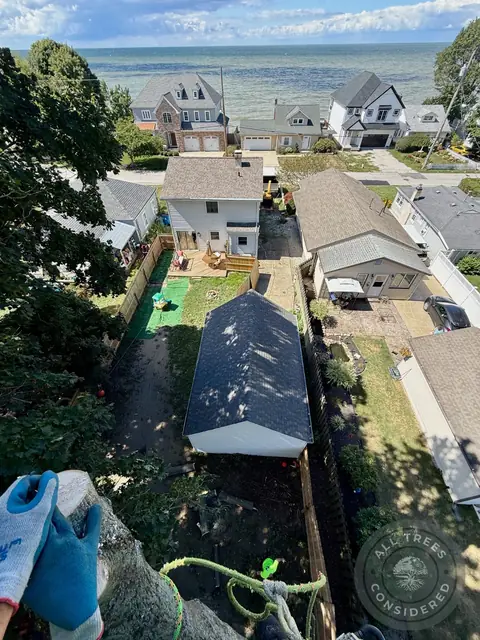
We work these trees with rope and rigging, taking weight off piece by piece in a controlled way, without needing to bring a crane into your yard. That approach is what lets us take apart a tree that is leaning on a house without dropping the rest of it on the house.
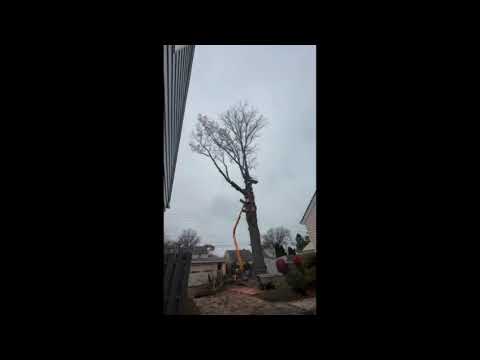
Here is Wes rigging down a dangerous leaning tree right next to a house, taking the weight off in pieces the way a storm-damaged tree has to come apart.
What Storm Cleanup and Removal Costs
Storm removal does not have a flat price the way a stump does, and anyone quoting you a firm number sight unseen is guessing. What it costs comes down to the size of the tree, what it landed on, how hard it is to reach, whether it has to be rigged down in pieces or can be dropped in one, and whether the call comes in at 2 in the afternoon or 2 in the morning. Emergency after-hours work on a tree threatening an occupied home is priced case by case, because the crew and the risk are different from a scheduled job on a calm Tuesday.
If the tree hit a covered structure, your homeowner’s policy may pick up the removal, and your deductible applies to that. The clean number the site does publish is for stumps: once a storm tree is down and cut up, the stump left behind grinds out at a predictable rate, and you can see what a leftover stump costs to grind in that guide. For the storm work itself, the honest move is to request a free quote so someone can actually look at what you are dealing with.
Storm Damage in Chardon, Geauga County, and Lake County
This corner of Ohio gets more storm tree work than most, and the reasons are baked into where we live. Most tree damage from a storm around here traces back to a few predictable causes. Chardon sits in the state’s snow belt and takes some of the heaviest lake-effect snowfall in Ohio. Wet, heavy snow loads up evergreen canopies until limbs bend to the ground or split out of the trunk. Ice storms do worse. They freeze onto branches and pull apart the unions that hold a tree together, and a big hardwood can shed half its crown in a single night of ice.
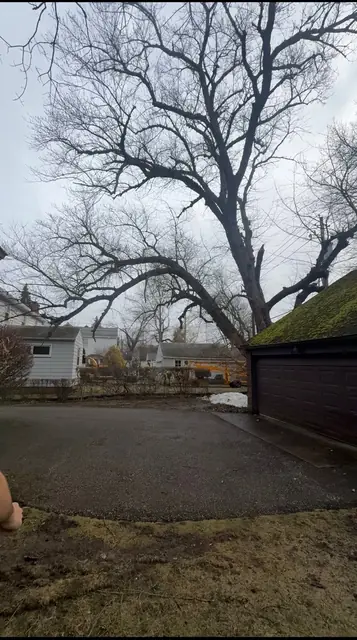
Geauga County also has one of the densest tree canopies in the region. Mature oaks and maples line the older neighborhoods, tall pines stand on the rural lots, and ash trees, the ones the emerald ash borer has been killing off for years, are everywhere. Those dead and weakened ash are some of the most reliable storm failures we see, because a dead ash has no flex left in it and simply snaps. When a band rolls through, they are the trees that come down first.
Because Wes is based right in Chardon, the response is fast. There is no waiting for someone to drive in from the west side of the county. For a tree on an occupied home, we can often be on-site within the hour. The pattern holds through the year. Spring wind exposes the limbs that cracked over winter, and summer brings its own wind events. Then winter turns into the response work itself, out in the dark and the cold clearing what the lake-effect snow drops overnight.
When We Respond (24/7 Emergency Tree Service)
All Trees Considered runs a 24/7 emergency response for dangerous tree situations. During a major storm we triage the calls by severity, and trees on occupied homes always come first. If your situation is not immediately dangerous, we may schedule you into the storm cleanup work once the emergencies are handled, and we will tell you honestly where you fall in that line.
We are fully insured, and Wes runs every job personally. Call Wes at (440) 901-0995 for emergency tree service anywhere in Geauga or Lake County.
Frequently Asked Questions
What should I do right after a storm damages a tree?
Get clear of the tree and keep everyone back from anything touching a power line. Call 911 for injuries, your utility for downed lines, and your gas company if you smell gas. Once you are safe, photograph the damage before any cleanup, then call a tree service to assess it. Do not start cutting a storm-damaged tree yourself.
What happens if a tree falls on my house?
Get everyone out of the house if you can do it safely, and stay out of the attic and off the roof. Do not try to move the tree or climb up to inspect it. Photograph the damage for your insurer, call your homeowner’s insurance to start a claim, and call a tree service to take the tree off the structure safely. If lines were pulled loose, leave the power to the utility.
Who is responsible if a tree falls during a storm?
As a general rule most insurers follow, a tree that falls on your own property during a storm runs through your own homeowner’s policy, whether it was your tree or a neighbor’s. Negligence, like a known dead tree that was never dealt with, can change that. This is general information, not legal advice, so confirm coverage with your own insurer.
What if my neighbor’s tree fell on my property?
Most of the time it still goes through your insurer first, even though it was the neighbor’s tree. If the neighbor was negligent, your carrier may pursue their carrier to recover the cost. Do not assume the neighbor simply pays. Check with your own insurance company before you agree to anything.
How do I know if a storm-damaged tree can be saved?
It leans toward saving if the main trunk and top leader are intact, the breaks are clean, the root plate is solid, and only a small part of the crown is gone. It leans toward removal if the trunk or leader is split, the root plate lifted, cracks run down the stem, or the tree took on a new lean during the storm. A close-up read from someone standing under it is what settles it.
Should I remove a downed tree myself?
We do not recommend it. Storm-downed trees hold stored tension, so limbs are spring-loaded and trunks split unpredictably once you cut into them. Add chainsaw kickback, unstable footing, and the chance of a hidden power line, and it is the most dangerous tree work there is. This is a job for a crew with rigging.
Does homeowner’s insurance cover storm tree removal?
Usually when the tree hits a covered structure like the house, garage, or a fence, removal may be covered and your deductible applies. A healthy tree that falls in the open and hits nothing is often not covered for removal. Policies vary, so check yours or ask your agent.
How fast can you respond to a tree emergency in Geauga or Lake County?
Because Wes is based in Chardon, response is fast, and for a tree on an occupied home we can often be on-site within the hour. Call (440) 901-0995 any time, day or night.
Get a Downed Tree Handled Fast
When a storm drops a tree on your property, the safe move is to get everyone clear, document it, and let someone with the right gear take it apart. We answer the phone 24/7 and cover Chardon, all of Geauga County, and Lake County. Call Wes at (440) 901-0995, or request a free quote if it is not an emergency and you want it looked at.