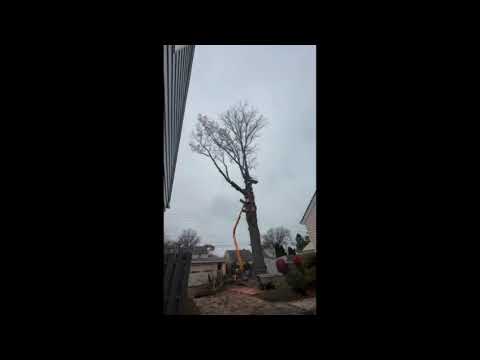

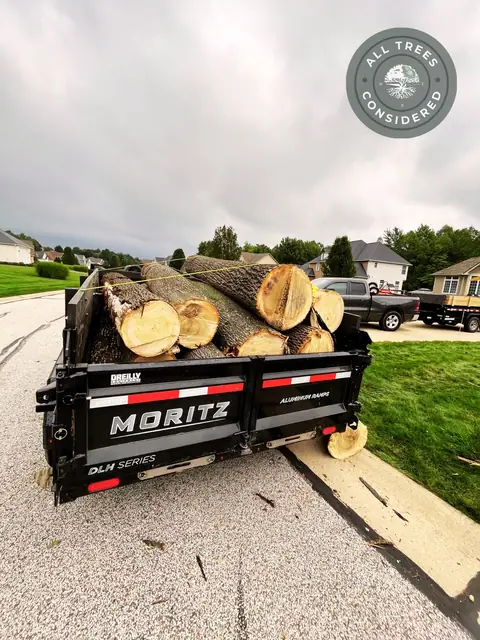
Most of the trees we take down in Geauga and Lake County end up as somebody’s firewood. Sometimes it is the homeowner’s. One estimate we wrote this year had the wood cut to 14 inches so it would fit the customer’s cast iron stove. Sometimes it goes to the curb and a neighbor with a trailer shows up before we finish loading the chipper.
So we get the question a lot: is this tree worth keeping for firewood? Short answer for Northeast Ohio: if it is hickory, oak, black locust, sugar maple, ash, or beech, yes, keep it. Cherry and walnut are good. Silver maple, elm, poplar and cottonwood will heat your house but you will feed the stove more often. Pine, spruce and hemlock are kindling and fire pit wood.
The rest of this is the full ranking, with the heat numbers from university extension charts and the things that matter more than the chart: how long each one takes to dry, which ones split easy, and which ones throw sparks. We do not sell firewood. We cut trees down, and if you want the wood, we leave it for you. More on that at the end.
How firewood is measured
Firewood heat is rated in million BTU per cord. A full cord is a stack 4 feet high, 4 feet deep and 8 feet long, 128 cubic feet (University of Nebraska Extension, NebGuide G1554). A “face cord” is the same 4 by 8 face but only one log deep, usually 16 inches, so a third of a cord or less. A “rick” means whatever the seller wants it to mean. Illinois Extension warns that a face cord and a rick are often smaller than people assume when they are buying (Illinois Extension, buying and selling firewood).
A pound of dry wood holds about the same heat no matter the species. Denser wood packs more pounds into a cord, which is the whole reason oak beats poplar. Two things cut the number in half for any species: moisture and bad burning. We will get to both.
The numbers below come from two extension charts that do not fully agree, the Nebraska NebGuide and a Virginia Tech forestry chart figured at 20 percent moisture. Where they differ I show the range. A 2 million BTU difference between sources is normal. A 10 million BTU difference between species is what you feel in February.
The ranking: trees that actually grow here
Ohio’s state tree may be the buckeye, but the trees we climb every week in Chardon, Mentor, Kirtland and Chagrin Falls are maples, oaks, ash, cherry, locust, hickory, elm, beech, poplar, and a lot of spruce and pine that somebody planted in 1975. That is the list ranked.
Tier 1: the best firewood in Northeast Ohio
| Species | Million BTU per cord | Notes |
|---|---|---|
| Shagbark hickory | 27.5 to 27.7 | Hottest common wood in our area. Long coals. Heavy to move. |
| Black locust | 27.9 to 29.3 | Rots slow, burns slow, few sparks per the Nebraska chart. Hard on chains. |
| White oak | 26.5 to 29.1 | The standard everyone else is measured against. Takes the longest to dry. |
| Apple | 26.5 to 27.0 | Rare in a yard removal. Smells like a bakery. |
| Mulberry | 25.8 | Great heat, many sparks. Stove with a door, not an open fireplace. |
Hickory is the one people remember. The biggest tree I have ever removed was a hickory, and the rounds from a trunk that size are more than one person can roll. If you are keeping hickory, have us cut it to length and leave it where the splitter can reach it, because you will not be carrying it anywhere.
Tier 2: good everyday firewood
| Species | Million BTU per cord | Notes |
|---|---|---|
| Sugar maple (hard maple) | 24.0 to 25.5 | Our most common removal. Splits clean, dries in a year, burns steady. |
| Red oak | 24.0 to 24.6 | Nearly as good as white oak and more common in yards here. Slow to season. |
| American beech | 24.0 | Beech leaf disease is killing a lot of them in Lake County. The wood is still excellent. |
| White ash | 23.6 | See the ash section below. There is a lot of it standing dead right now. |
| Green ash | 20.0 to 23.0 | Lighter than white ash, still a good burner. |
| Black walnut | 22.2 to 22.3 | Good heat, easy to split, slow to catch per Illinois Extension. Not a lumber tree once it has yard nails in it. |
| Red elm (slippery elm) | 21.6 | The good elm. |
| Hackberry | 20.8 to 21.2 | Fine wood, easy to work. |
Maple is the tree we take down more than any other, by a wide margin. A removed sugar maple is a year of free heat sitting in your yard. Silver maple, which is the fast growing one that drops limbs in every wind storm, is a tier lower.
Tier 3: burn it because it was free
| Species | Million BTU per cord | Notes |
|---|---|---|
| Black cherry | 19.9 to 20.4 | Easy to split, smells good, moderate heat. Nice shoulder season wood. |
| American elm | 20.0 to 20.2 | Decent heat, miserable to split by hand. Rent the splitter. |
| Paper birch | 20.3 to 20.8 | Burns fast. Bark is the best natural fire starter there is. |
| Sycamore | 19.5 to 20.7 | Stringy, tough to split, burns fine once it is dry. |
| Silver maple (soft maple) | 18.7 to 19.5 | Dries fast, burns fast. Fine for fall and spring. |
| Boxelder | 18.3 | A maple in name only. Burn it in the fire pit. |
| Willow | 17.6 | Low heat, lots of ash. |
| Cottonwood | 13.5 to 16.1 | Lowest heat of the hardwoods. Takes up a lot of room for what it gives. |
| Yellow poplar (tulip tree) | Not rated in the charts above | Light, fast burning, easy to split. Kindling and fall fires. |
None of these are bad. A cord of silver maple will keep a stove going; you will just load it twice as often as you would with locust. The mistake is paying for them at hardwood prices, not burning them when they came off your own lot.
Softwoods: kindling and the fire pit
| Species | Million BTU per cord | Notes |
|---|---|---|
| Eastern red cedar | 18.2 | Smells great, throws sparks. Outdoors. |
| Eastern hemlock | 15.9 | Low heat. Outdoor fire pit wood. |
| White pine | 14.3 to 15.6 | Kindling. It dries fast and lights easy. |
| Spruce | 15.5 | Same. Many sparks per the Nebraska chart. |
We take down a lot of spruce and white pine in Lake County, usually a windbreak row that got too big for the lot. The wood is not worthless. It is the best kindling you will ever have, and it is fine in a fire pit. Inside a stove it burns fast and the Nebraska and Illinois charts both flag it for sparks, so keep the door shut.
The ash problem, and the ash opportunity
Emerald ash borer has reached every county in Ohio, and in Geauga and Lake County that means a lot of ash trees standing dead in yards and along the road. We get called for them every week. Dead ash is dangerous to leave: once the bark starts shedding, the limbs go brittle and the tree sheds big pieces in wind. That is why we remove so many of them.
The upside is that ash is one of the best firewoods on the list, and an EAB-killed tree has often been drying on the stump for a year or two already. Ash also has a reputation for burning acceptably before it is fully seasoned, because it starts out lower in moisture than oak. Still test it. One warning from Ask Extension: if the tree was chemically treated for borer at some point, the wood cannot be guaranteed safe to burn. If you had a tree service injecting your ash, ask what they used before you put that wood in the stove.
Black walnut: good firewood, with one caution for gardeners
Walnut comes up because people have heard the tree poisons everything under it. The chemical is juglone, and Iowa State Extension says it is present in only small amounts in the wood and breaks down quickly in soil, so walnut wood chips are not the mulch disaster people expect. The roots and hulls are where it concentrates. We took a large black walnut down at a customer’s daughter’s house and delivered the chips to his own property for trail building, which is about the best use of walnut chips there is.
As firewood, walnut is in the middle of the pack: 22 million BTU, splits easy, low smoke, slow to start. Keep it.
Seasoning: the part that matters more than the species
Every number above assumes dry wood. Freshly cut wood is heavy with water, and all of it has to boil off before the wood gives you any heat. OSU Extension in Fairfield County puts it plainly: for every 1 percent increase in wood moisture there is a 1 percent decrease in heating value, and green wood also generates creosote that builds up in the chimney. Creosote is what chimney fires are made of. Illinois Extension says the same thing.
What the extension services recommend, and what works in our climate:
- Target under 20 percent moisture. That is the number Nebraska Extension uses. A pin moisture meter costs about what a tank of gas does and ends the argument. Split a piece and test the fresh face, not the outside.
- Give it 6 to 12 months, and plan a year ahead. Nebraska’s advice is to cut firewood one year before you need it. Maple, ash, cherry and the softwoods dry on the short end. Oak is the slow one; give it the full year and check it.
- Split it now, not later. Wood dries from the cut faces. A round with the bark on it barely dries at all. Split within a few weeks of the removal and you are months ahead.
- Stack it off the ground with the top covered and the sides open. Pallets, rails, anything that gets the bottom row out of the mud. Covering the whole pile with a tarp traps the moisture you are trying to get rid of.
- Stack it in the sun and wind. The north side of the garage in a Chardon winter is where firewood goes to stay wet.
Here is the simple rack I built for my own wood. Off the ground, open sides, nothing fancy.
Do not move it, and do not burn these
Burn it where it fell. Ohio has 51 of its 88 counties under a spongy moth quarantine, and it is against the law to take firewood out of a quarantined area (OSU Buckeye Yard and Garden Line). Clermont County has its own rule for Asian longhorned beetle. The Don’t Move Firewood Ohio page has the current map and the plain rule: buy local, burn local. Firewood is how spongy moth and emerald ash borer travel, which is why the rule exists. Firewood from your own yard, burned in your own yard, is never the problem.
Spotted lanternfly. As of February 2026 the whole state is under a spotted lanternfly quarantine. The regulated items are nursery stock and trees leaving Ohio, but the egg masses stick to anything flat, including split wood, so look at a pile before it goes anywhere.
Never burn treated or painted wood. Pressure treated lumber, painted or stained boards, old deck, pallets you are not sure about, and anything with creosote in it. The Wood Heat Organization is blunt about it and so are we. A tree we cut down is clean wood. The fence it fell on is not.
Keeping the wood from your own removal
This is the part we can actually help with. When you get a quote from us, tell us you want the wood. What that usually looks like:
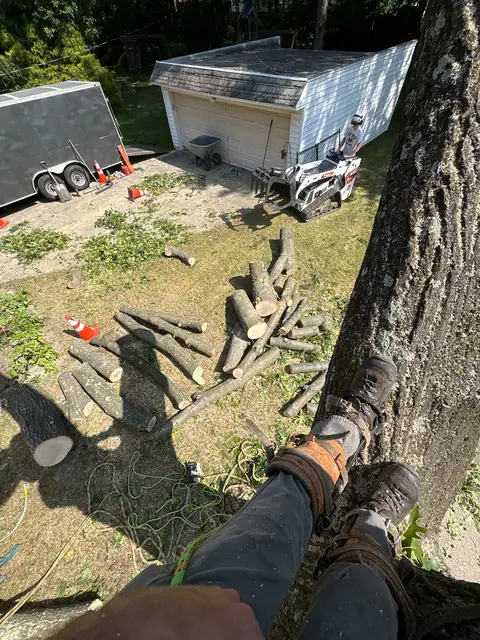
- We cut the trunk and the big limbs to the length you want. Sixteen inches is the common stove length. We have cut to 14 for a customer’s cast iron stove.
- We pile it where you tell us to, within reason. Where the splitter sits, not where the truck cannot go.
- Brush and small limbs still get chipped. You are keeping firewood, not a brush pile.
- Splitting and stacking are extra. We have done it, and one customer’s review is about exactly that, but it is a separate line on the estimate, so ask.
Hauling away a big tree’s worth of logs is real work and real trailer space. When you keep the wood, that work comes off our side, and the estimate reflects it. The amount depends on the tree, so it is a conversation at the quote, not a flat number.
If you do not want it, we take it. Some of it ends up as firewood for us. The rest goes to the curb when a customer asks, and in this county somebody with a trailer will have it gone by dark.
Frequently asked questions
Is ash good firewood?
Yes. White ash rates around 23.6 million BTU per cord on the Virginia Tech chart and green ash 20 to 23, which puts it with the oaks and maples. It splits easily and has a reputation for seasoning faster than oak. With emerald ash borer in every Ohio county, standing dead ash is the most common firewood source in Northeast Ohio right now. Have it removed before it sheds limbs on its own.
Is maple good firewood?
Sugar maple, also called hard maple, is very good: 24 to 25.5 million BTU per cord, clean splitting, dries in a year. Silver maple and other soft maples are closer to 19 and burn faster. Both are worth keeping when they come off your own property.
Is pine good firewood?
For kindling and the fire pit, yes. For heating a house, no. White pine rates 14 to 15.6 million BTU per cord, about half of hickory, and the extension charts flag spruce and pine for sparks. It is fine in a stove with the door closed once it is dry, and it is the easiest wood to get a fire started with.
How long does firewood take to season?
Six to 12 months for most hardwoods, according to Nebraska Extension, which recommends cutting a year before you burn. Oak takes the longest. Split it soon after the tree comes down, stack it off the ground with the top covered and the sides open, and test with a moisture meter. Under 20 percent is the target.
Can I keep the wood when you take my tree down?
Yes. Say so when you ask for the quote. We cut the trunk and large limbs to the length you want and pile them where you can get to them. Brush still gets chipped. Splitting and stacking can be added as a separate item.
Is black locust good firewood?
Excellent. The charts rate it 27.9 to 29.3 million BTU per cord, the highest of any common tree in this area, and the Nebraska chart lists it as a low sparking wood. It is hard to cut and very hard to split once it dries, so split it green.
Have a tree that needs to come down?
We are a working tree service based in Chardon. We climb and rig trees down in pieces without a crane, across Geauga and Lake County, and if you want the wood, it is yours. Call (440) 901-0995 or request a quote, and tell us what length your stove takes.