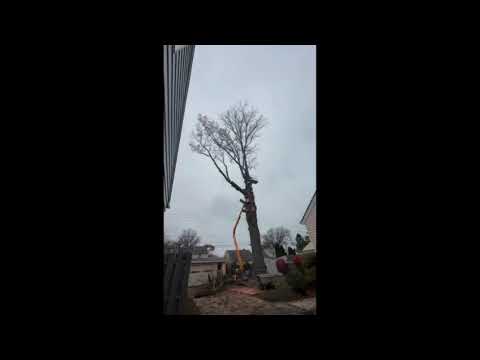

The question comes in two ways. In June somebody calls and asks if we can trim the oak over the patio before the graduation party. In January somebody asks if it is too cold to trim anything. The June oak gets a no from us, and the January tree gets a yes, and the reasons are the whole point of this post.
Short version for Geauga and Lake County: late winter is the best time to trim most trees. February and March, before the buds break. Oaks are the big exception, and we do not put a saw in a live oak between April and October. Flowering trees that bloom in spring get trimmed right after they bloom. Dead wood, broken limbs and anything hanging over a roof come off whenever we see them.
The month by month calendar is below. First, why the time of year matters at all.
Why late winter wins
Three reasons, and the university extension offices agree on all of them.
You can see the tree. With the leaves off, the structure is right there: crossing branches, included bark, the limb that is dead from the trunk out, the lean nobody noticed. University of Illinois Extension puts it plainly: pruning a dormant tree “gives the pruner an increased visibility of the tree’s shape without any leaves” (Illinois Extension, Sarah Vogel, 2022). From the saddle this is the difference between guessing and knowing.
The cut seals fast. A pruning cut is a wound. Make it in late winter and the tree starts growing over it within weeks when spring hits. Same Illinois article: “The plant will seal wounds properly to prevent the spread of decay and entry for potential pests and pathogens.”
The bugs are asleep. The insects that carry tree diseases are not flying in February. That matters most for oaks, which get their own section.
University of Minnesota Extension sums it up the same way: “The late dormant season (late winter to early spring) is best for most pruning” (UMN Extension, Pruning trees and shrubs). Minnesota’s winters are harder than ours. The advice carries.
One more practical reason that no extension sheet mentions. Frozen ground. A lift or a chipper on a frozen lawn leaves no ruts. The same machine in April sinks.
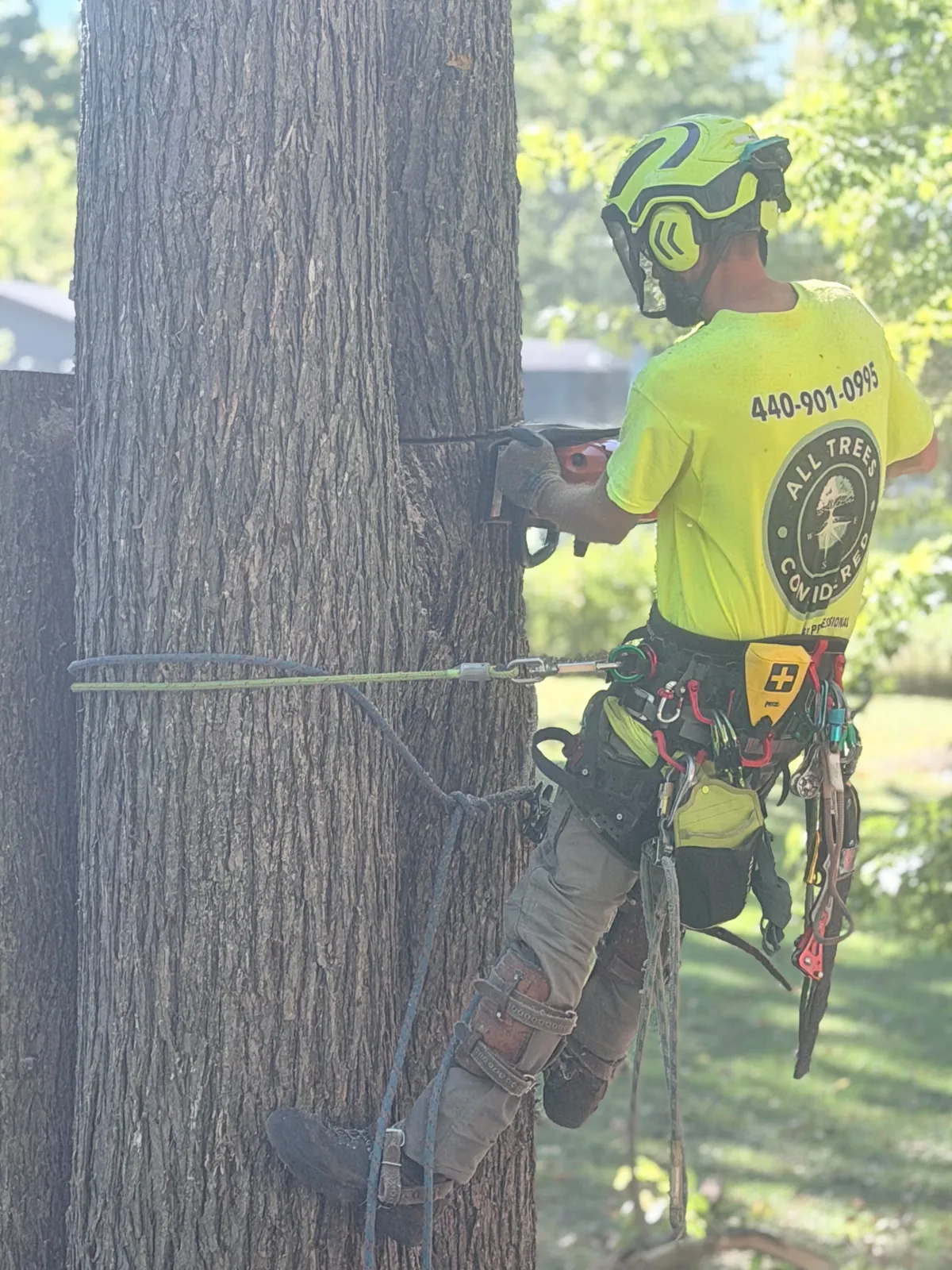
When to trim oak trees: never April through October
Oak wilt is a fungus that kills red oaks fast. Ohio State’s fact sheet says red and black oaks “are extremely susceptible and can die within a few weeks of infection,” while white oaks “are more tolerant of the disease and may survive infection for one or more years” (OSU Extension, PLPATH-TREE-02, Oak Wilt). It is in Ohio. There is no cure for an infected red oak.
The fungus moves two ways. Underground, through root grafts between neighboring oaks, which OSU estimates accounts for about 90 percent of new infections. Above ground, by sap feeding beetles that land on a fresh wound carrying spores from an infected tree. A pruning cut in June is exactly that wound. OSU’s minimum is no wounds between April 15 and July 1, and its stricter advice is to “avoid wounding the trees throughout the growing season (April 15–Oct. 1).” Minnesota Extension says it in capitals: “DO NOT prune oaks from April to October.” The Ohio Chapter of the International Society of Arboriculture goes further still, bud break to leaf drop, which it puts at April through November (Ohio Chapter ISA).
Our rule is the strict one. We trim oaks from November through March. If you call in June about an oak, we will come look at it, and unless a limb is broken or hanging, we schedule it for winter. A homeowner is sometimes annoyed by that. The alternative is a dead oak that was a hundred years old.
If an oak gets wounded in summer anyway, a storm break or a mower hit, OSU says “it is imperative to dress the wounds,” and that latex paint works. This is the one case where we paint a cut. Every other tree, every other time of year, the cut is left open to seal on its own.
Maples bleed. It looks worse than it is
Geauga is Ohio’s maple county, and the question about maples is always about the sap. Trim a sugar maple in late February or March and the cuts run. Minnesota Extension lists maples, birch, walnut and butternut as the bleeders and says “though this bleeding causes little harm, it may still be a source of concern” (UMN Extension). Their alternative is to prune those species after the leaves are fully out in late spring or early summer.
Either window works for a maple. We trim a lot of them in January and February before the sap runs hard, and the ones we trim in June are fine too. What we avoid is heavy cuts on a sugar maple in the middle of sap season for a customer who taps it.
Flowering trees: right after the bloom
Magnolia, lilac, flowering cherry, flowering plum, redbud and the other spring bloomers set next year’s flower buds over the summer. Trim them in winter and you cut off the show. Minnesota’s guidance is that they “should be pruned immediately after they finish blooming.” So a magnolia in Mentor gets trimmed in May, right after the petals drop. Crabapples and apples are the exception in that group, pruned in late winter with everything else.
Dead, broken and dangerous: any day of the year
None of the calendar applies to dead wood. A dead limb is not going to heal, and it is not going to spread a disease it does not have. The same goes for a broken limb hanging over a driveway, a split leader, a branch rubbing the roof. We take those off the day we are there, in any month. Dead ash is the big one in this area. Emerald ash borer killed most of the ash in Lake and Geauga County, and a dead ash gets brittle quickly. Those we take down as soon as the schedule allows, not when the calendar says.
One of our customers, Mark Hampton, had a large limb come down in a rain storm. We were there the next day, took the branches away and trimmed the broken limb back to a clean cut. That is the storm calendar: now.
The Northeast Ohio trimming calendar
| Month | Trim these | Hold off on these |
|---|---|---|
| January | Oaks, maples, most shade trees. Best visibility of the year. Frozen ground, no ruts. | Spring bloomers (magnolia, lilac, redbud). |
| February | Oaks, maples (expect sap), fruit trees and crabapples, most everything. | Spring bloomers. |
| March | Last clean month for oaks. Fruit trees, shade trees. Maples will bleed, which is fine. | Spring bloomers. |
| April | Dead wood, storm damage, hazard limbs. | Oaks. Rule starts April 1 for us. Spring bloomers until they finish. |
| May | Magnolia, lilac, cherry, redbud right after bloom. Dead wood. | Oaks. |
| June | Maples, birch, walnut if you want no sap. Clearance trimming over roofs and drives. Dead wood. | Oaks. Heavy pruning on anything in a drought. |
| July | Light clearance and dead wood. Storm cleanup. | Oaks. Heavy cuts on stressed trees. |
| August | Light trimming, dead wood, storm cleanup. | Oaks. |
| September | Dead wood, hazard limbs. Plan the winter list. | Oaks. New growth from a heavy fall cut will not harden before frost. |
| October | Dead wood. Removals of any species. | Oaks until the leaves are down. |
| November | Oaks are back on once the leaves drop. Shade trees. Pre winter hazard checks over the house. | Spring bloomers. |
| December | Oaks, shade trees. We book light in December, so call early for a date. | Spring bloomers. |
Two notes on the table. Removals are not on it because a tree that is coming down does not need to heal. We take trees down in every month, oaks included. And “light trimming” in summer means clearance cuts and small limbs, not taking a third of the canopy off a tree that is already working hard through a dry August.
How much to take at once
A tree feeds itself with its leaves. Take too many at once and it starves while it tries to regrow them. The working rule in the trade is no more than a quarter of the live canopy in one year, and less on an old tree. If a tree needs more than that to clear a roof or fix a bad structure, we do it over two or three winters. A tree service that offers to “open it up” by half in one visit is selling you a tree that will throw water sprouts for years and then start to decline.
Topping, meaning cutting every limb back to a stub, is never on the calendar. Any month, any species. We wrote about why tree topping is bad in an older post, and the short answer is that it ruins the tree.
What a trimming visit looks like
Dennis Dervay had us trim the trees around his deck and take two trees down that were leaning over his garage. His review afterward: “They did a very good job in insuring no damage occurred and hauled away the trees and cleaned up.” That is the standard. Cuts made at the branch collar so they seal, no stubs, no flush cuts, limbs lowered on rope where there is anything underneath, brush chipped and the lawn raked before we leave.
If you want a tree looked at before you decide, that is a free estimate. We will tell you what should come off, what should wait for winter, and what should be left alone.
Frequently asked questions
When is the best time to trim trees in Ohio?
Late winter, February and March, for most trees. Oaks only from November through March because of oak wilt. Spring flowering trees right after they bloom. Dead or broken limbs any time.
Can you trim trees in the summer?
Yes, with limits. Dead wood, broken limbs and clearance cuts over a roof or driveway are fine in summer. Heavy pruning in a hot dry stretch stresses the tree, and oaks should not be cut at all between April and October.
Is it OK to trim trees in the fall?
Dead wood and hazard limbs, yes. Hold off on heavy pruning until the leaves are down, because a big cut in September pushes new growth that will not harden before frost. Oaks wait until leaf drop.
Why won’t you trim my oak in June?
Oak wilt. Sap feeding beetles carry the fungus to fresh cuts in the growing season, and Ohio State says a red oak can die within a few weeks of infection. We trim oaks November through March. If a limb is broken, we will cut it and paint the wound.
Will trimming my maple in winter hurt it?
No. It will bleed sap in late winter, which university extension offices say causes little harm. If the dripping bothers you, we can trim it in June after the leaves are out.
How often should trees be trimmed?
Most mature shade trees every three to five years. Young trees more often, a light structural trim every two or three years, so they grow right and need less later. Trees over a house or a driveway get looked at every year.
Need a tree trimmed this winter?
Winter is when we do our best trimming work and it is the only time we trim oaks. Get on the list now and the frozen ground does the lawn a favor. Tree trimming and pruning is the service page, and storm cleanup is the one to call if something is already on the ground. Free estimates across Geauga and Lake County.